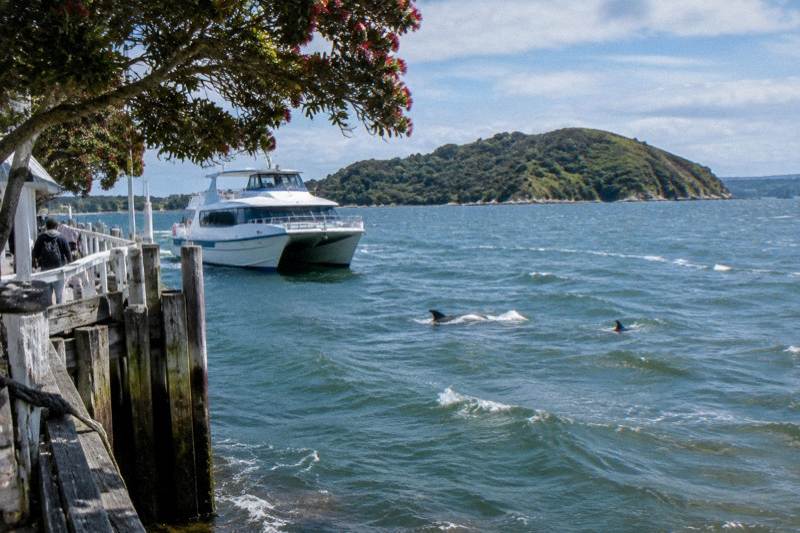
Is It Safe To Swim With Wild Dolphins In The Ocean?
Swimming with dolphins is not permitted in the Bay of Islands. Here is what the sanctuary rules say, the penalties, and which dolphin watching cruises from Paihia and Russell are the legal alternative.
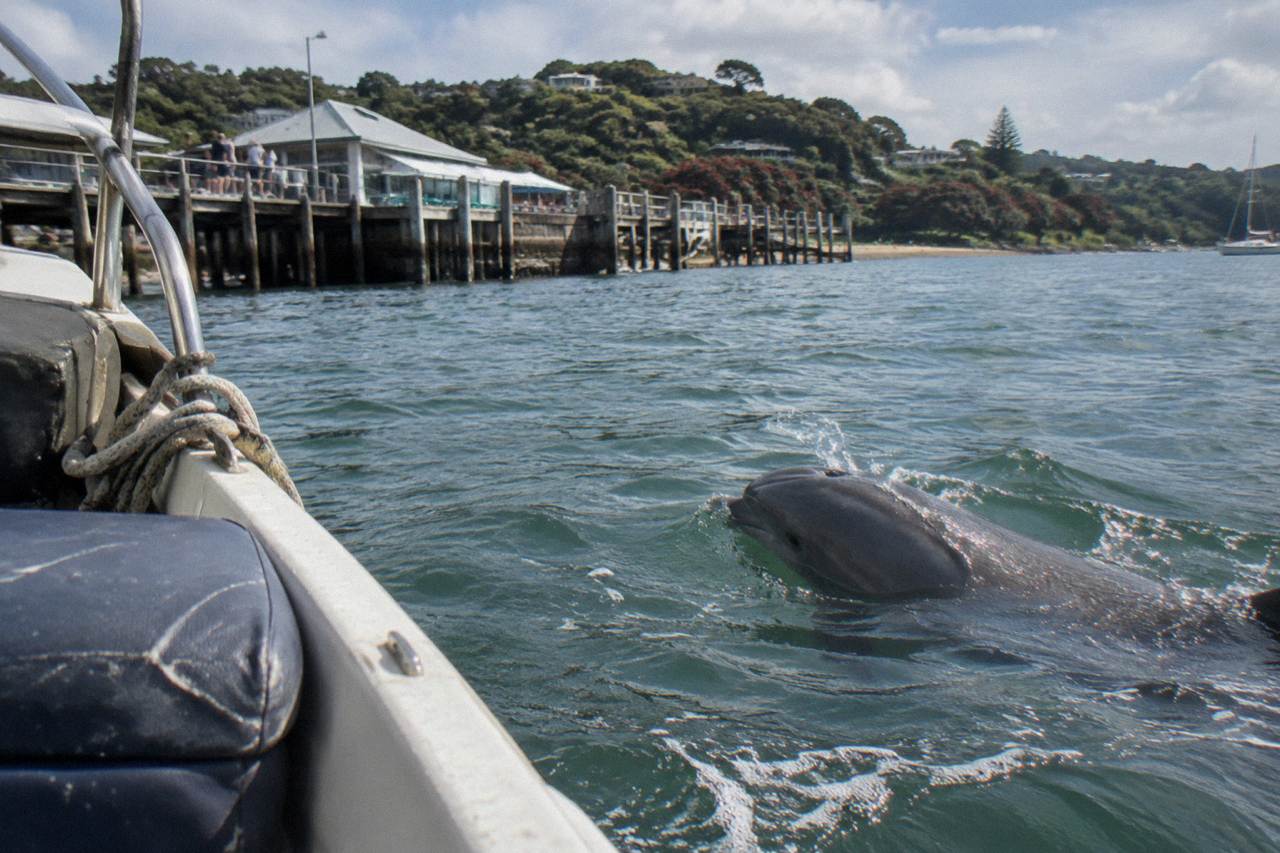
No, and in the Bay of Islands the question is settled by law rather than judgement. Swimming with dolphins is not permitted here: the Te Pewhairangi Marine Mammal Sanctuary keeps everyone out of the water within 300 m of any dolphin, whale or seal, and vessels must stop within 300 m and stay stopped until the animal moves away. The rule covers swimming, snorkelling, diving and freediving, with no exception for strong swimmers, adults or supervised groups. What remains safe and legal is watching from the deck of a cruise boat, which is exactly what the dolphin cruises from Paihia and Russell are built for. For the full picture on where swimming with dolphins is banned across the country and which cruises you can book instead, see the guide to swimming with dolphins in New Zealand and what the rules allow.
The safety question people actually arrive with is usually softer than the legal one. Wild dolphins are large, fast, powerful animals, and any encounter in open water involves an animal that chooses to be there or not, on its own terms. But in this bay the discussion never reaches that stage, because the sanctuary rules, in effect since 15 December 2021 under the Marine Mammals Protection Act 1978, take the decision out of individual hands. The Department of Conservation states it plainly: no one is allowed in the water within 300 m of a marine mammal in this sanctuary, and the local rule takes priority over the national regulations that govern the rest of the country's coastline.
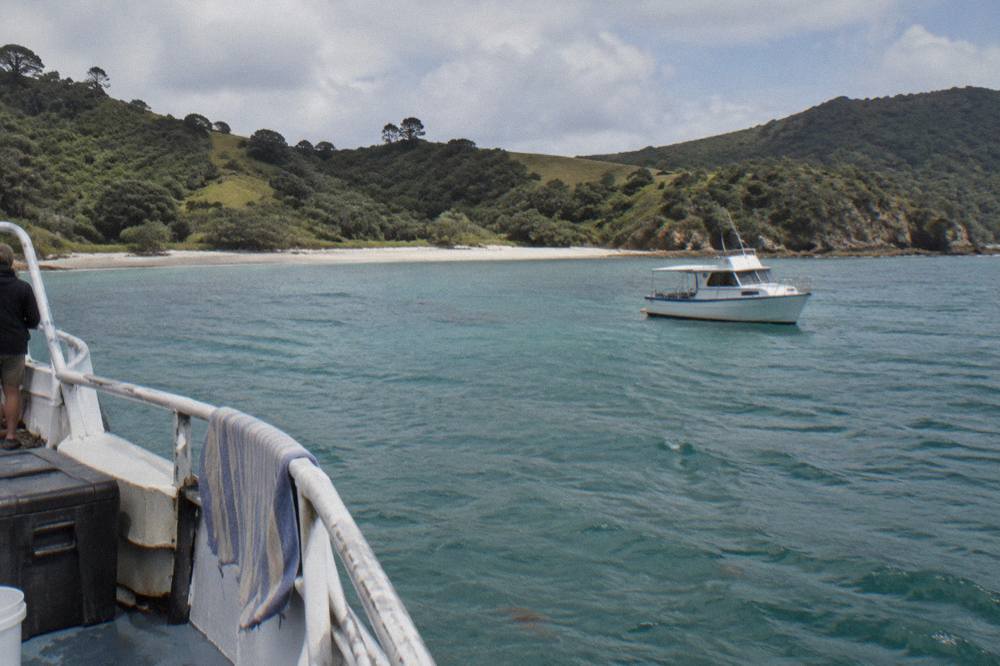
That is the honest starting point for planning a day on the water here. The tours covered here are watching trips: boats that cruise among more than 140 islands, keep a lawful distance, and let passengers watch from the rail; an operator wildlife guide lists bottlenose and common dolphins and occasional orcas in the bay, and a sighting is never promised. One example is the Explore Group Hole in the Rock, Dolphins and Island Cruise, about 4.5 hours from Paihia and Russell, from $90 per person, rated 4.6 across 902 reviews, with dolphins named in the operator's own description and an island stop on Urupukapuka. If a worry about safety was steering you away from a swim, a watching cruise is the choice that removes the risk question entirely.
Why Is Swimming With Dolphins Banned In The Bay Of Islands?
The ban exists because the local bottlenose population has fallen sharply and human interaction is identified as the main pressure. A 2025 NIWA report for DOC estimates 40 bottlenose dolphins in the bay, down from 244 in summer 1997, with a low of 16 in summer 2019, and concludes the decline merits management intervention. The sanctuary, gazetted on 17 November 2021 and in force from 15 December that year, is the management response. Keeping people and vessels at distance is the tool, and swimming is the first thing it removes.
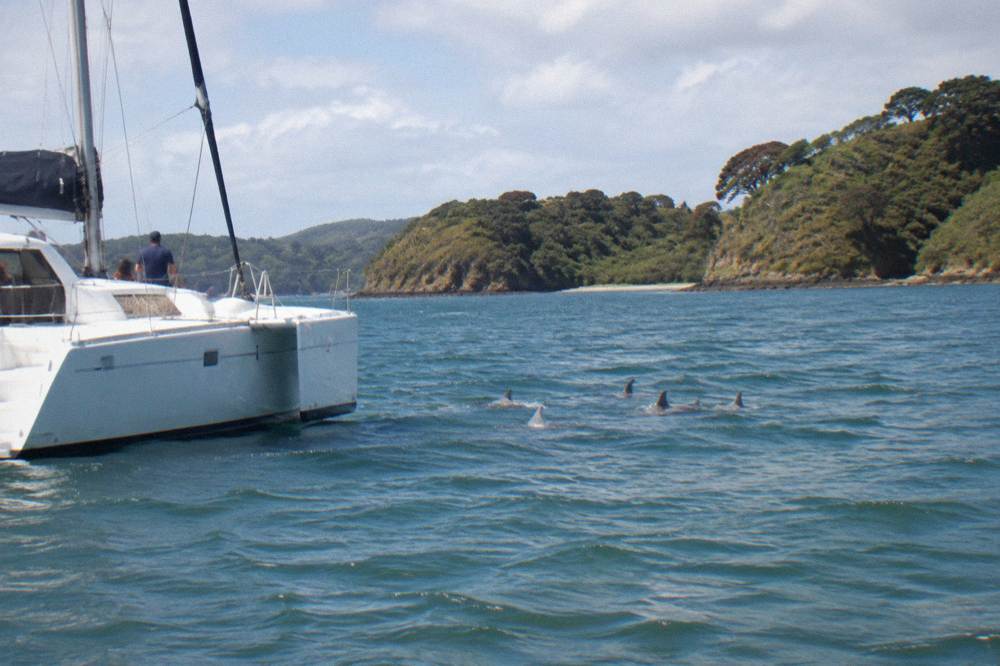
The numbers behind the rule are worth knowing before you board any boat. DOC's species page records 26 individual dolphins visiting the Bay of Islands area from 2020 data, within a North Island coastal population of about 450 animals from Doubtless Bay to Tauranga. The long-run study behind the 2025 report photo-identified 540 unique individuals across 1,605 daily surveys spanning 1994 to 2024, and found calf mortality here high compared with other areas. DOC also notes that bottlenose dolphins spend 86 percent of daylight hours surrounded by vessels or humans. That figure alone explains why a bay full of boats decided to draw a hard line.
The rules themselves are straightforward to follow from a passenger seat. People keep out of the water within 300 m of any marine mammal. Vessels keep 300 m from dolphins, whales and seals alike, and if a marine mammal comes closer than that, the boat stops and stays stopped until the animal is more than 300 m away. DOC research suggests a few minutes is usually enough for an animal to move off. The DOC sanctuary page sets out the full rules, and commercial skippers operating dolphin cruises hold DOC licences that carry extra obligations. None of that demands anything of a passenger beyond staying on board and enjoying the show.
What Happens If You Do Swim With Dolphins Here?
If you choose to swim with dolphins here, the consequences are serious: infringement fees of $400, $600 or $800 can apply, and if you are prosecuted you could face up to two years in prison or a fine of up to $100,000. In short, the risk is real, and no swim is worth that outcome. The enforcement wording is unambiguous, and it applies to every person in the water within 300 m of a marine mammal in the sanctuary.
The enforcement backdrop has history. In 2019, DOC imposed new commercial permit conditions that prohibited all swimming with bottlenose dolphins, closed Tapeka Point and Roberton Island to commercial permit holders, and cut total interaction time to 20 minutes per trip. Those 2019 permit conditions were the earlier, softer version of today's rules. When the sanctuary came into force in December 2021 it superseded the permit-by-permit approach for swimming, replacing it with a blanket distance rule that applies to commercial operators and the public alike. Nothing published since 2019 shows any reversal.
| Rule in the sanctuary | Who it applies to | What it means in practice |
|---|---|---|
| No person in the water within 300 m of any marine mammal | Everyone: swimmers, snorkellers, divers, freedivers | Swimming with dolphins, whales or seals is an offence |
| Vessels keep 300 m from all marine mammals | All boats, including tour vessels and kayaks | Tour boats hold distance or stop and wait |
| Vessel must stop if a mammal is closer than 300 m | All skippers | Engines idle until the animal moves beyond 300 m |
| Infringement fees | Any person who breaches | $400, $600 or $800 depending on the offence |
| Prosecution | Serious cases | Up to 2 years in prison or a fine up to $100,000 |
For a visitor, the practical reading is simple: the water is closed to you whenever a dolphin is within 300 m, and a boat is the only lawful platform for an encounter. A reader weighing whether a swim is safe now has a second answer stacked on the first: even setting animal behaviour aside, the legal risk sits entirely with the person who enters the water.
Can You Swim On A Bay Of Islands Dolphin Cruise At All?
Yes, swimming is possible on a Bay of Islands dolphin cruise, but only at island beaches and only when no marine mammal is within 300 m. Several cruises include an island stop where swimming, snorkelling and beach time are ordinary island activities, kept entirely separate from dolphin watching. The Explore Group Hole in the Rock, Dolphins and Island Cruise puts about 1.5 hours of its roughly 4.5 hours on the Urupukapuka Island stop at Otehei Bay, where the operator lists swim, explore or sunbathe options. Otehei Bay is the hub of the island, with a summer cafe, kayaking and paddleboarding, and a wharf served by scheduled ferries and tours.
On the tours covered here, a swim happens off a beach at an island stop, and dolphin watching happens from the deck with the vessel stopped at distance. The two never mix. If a tour includes snorkel gear, as the Island Getaway Hole in the Rock cruise with two island stops does, that gear is for the island stops, not for the water anywhere near a dolphin. The rest of the planning pages sit on Bay Of Islands Dolphin Cruises.
Urupukapuka itself rewards the stop. It is the largest island in the bay at 208 hectares, carries at least 66 recorded archaeological sites including at least eight pa, and its interpreted walk is designed to be walked clockwise from bays including Otehei. The DOC walk page gives the complete circuit at five hours, suitable for older children, though no cruise promises walking time. For most passengers the swim, the sand and the cafe fill the stop comfortably.
Is Watching Dolphins From A Boat Safe?
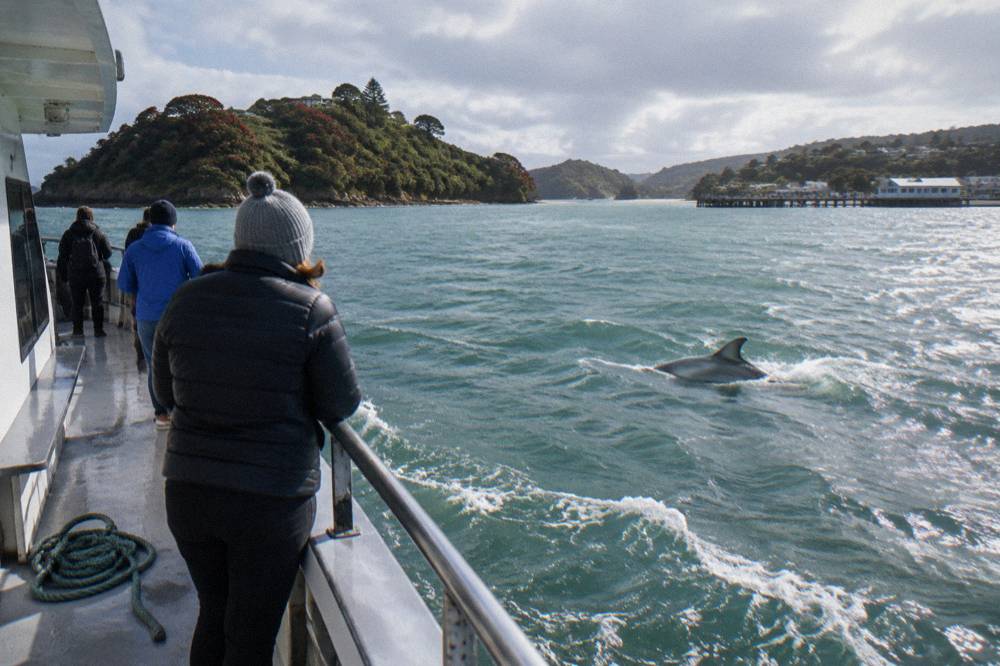
Yes, watching from a vessel is the low-risk way to see wild dolphins: the boat holds a lawful distance, the animals control the encounter, and the main safety considerations are ordinary ones like sun protection and staying seated while under way. Dolphin-watching operators hold DOC permits and tour vessels follow the sanctuary rules described above, which exist as much for the dolphins' welfare as for passengers. Nothing about a deck-based encounter asks you to share the water with a wild animal.
The species you are most likely to see, according to the operator wildlife guides, are bottlenose dolphins, common dolphins and occasionally orcas, with Bryde's whales, pilot whales, fur seals, penguins and seabirds also described in the bay. Common dolphins are described as abundant locally. How close any of that comes to the boat is the animals' choice; the rules only cap how close the boat may go. More on the species mix sits in the guide to bottlenose and common dolphins on a cruise, and the seasonal picture, including NIWA's finding that dolphin occurrence is lower in the winter months, is covered in when to take a dolphin cruise.
For passengers, the safety checklist is refreshingly dull: follow the crew's instructions, keep children supervised on deck, hold on when the boat is moving, and take sun protection seriously on the exposed outer decks. If rough-water motion is a concern, the planning notes in the guide to dolphin cruise seasickness cover what helps. Only one tour covered here, the Explore Group Day in the Bay cream trip cruise, states a dolphin viewing and marine mammal guarantee, and no other tour promises a sighting. For everything else, the honest framing is an opportunity to view, with mother nature deciding the rest.
Which Bay Of Islands Cruises Replace The Swim?
The legal alternative to a swim is a watching cruise, and in the dolphin-and-Hole-in-the-Rock category there are seven tours to pick from, with prices running from $88.87 to $131.87 per person and trip lengths ranging from three hours to about six, so you have real choice in both budget and time on the water. Cheapest in that group is the Island Getaway three-hour Hole in the Rock cruise at $88.87, rated 4.9 across 197 reviews, departing Paihia Wharf with a remote island stopover on Roberton Island. At the other end, the Carino Wildlife Cruises island and wildlife day cruise runs about six hours from Paihia with lunch and snorkel gear included, from $131.87, rated 4.9 across 52 reviews.
The Island Getaway Hole in the Rock cruise with two island stops is the most reviewed tour on this site, 4.8 across 1,217 reviews, about 4.5 hours from $101 per person from Paihia and Russell, with snorkelling equipment listed and two island stopovers. Its operator's description does not name dolphins, so treat marine wildlife as a lookout rather than a theme. The Explore Group Discover the Bay cruise with island lunch, 4.7 across 302 reviews and from $121, adds a buffet or main-menu lunch and a 1.5-hour Otehei Bay stopover, and its operator does mention dolphins. Between them they cover the spread of price, food and island time that a swim-planner turned watcher typically weighs.
| Tour | Duration | From (USD) | Rating | Departs |
|---|---|---|---|---|
| Explore Group Hole in the Rock, Dolphins and Island Cruise | About 4.5 hours | $90 | 4.6 across 902 reviews | Paihia and Russell |
| Island Getaway Hole in the Rock cruise, two island stops | About 4.5 hours | $101 | 4.8 across 1,217 reviews | Paihia and Russell |
| Explore Group Discover the Bay cruise with island lunch | 4.5 hours | $121 | 4.7 across 302 reviews | Paihia and Russell |
| Island Getaway three-hour Hole in the Rock cruise | 3 hours | $88.87 | 4.9 across 197 reviews | Paihia |
| Carino Wildlife Cruises island and wildlife day cruise | About 6 hours | $131.87 | 4.9 across 52 reviews | Paihia |
Free cancellation up to 24 hours before the start is stated on all five of these tours, so a weather-driven change of plan costs nothing if made in time. That matters more than usual on a wildlife trip, since sea conditions around the Hole in the Rock are always the operator's call.
What Should A Cautious Traveller Book Instead?
A watching cruise from Paihia or Russell is the right booking for a cautious traveller: from $88.87 for the shortest dolphin-category cruise, and from $90 for the featured Hole in the Rock, Dolphins and Island Cruise, with free cancellation stated up to 24 hours before. The decisions that matter are duration, vessel and island time. Three hours suits a nervous sailor testing the water, so to speak; about 4.5 hours with an island stop is the balanced default; a full day suits someone who wants lunch, snorkelling and a beach afternoon built in.
Bay Of Islands Dolphin Cruises, this site, exists because the swim question comes up constantly and the answer keeps changing people's plans toward a deck, a pair of binoculars and an island beach. For the full field of 22 tours, including sailing yachts, tall ships, fast boats, overnight cruises and Auckland day trips, the Bay of Islands tours compared guide lays out every category side by side, and which Hole in the Rock cruise to book narrows the most-asked comparison.
For anyone still holding a safety worry: in this bay the animals are watched at distance from a vessel, and the water near them is closed to everyone equally. A watching cruise is not the compromise version of a swim. It is the version that lets a fragile population of bottlenose dolphins, 40 animals at the latest estimate, go on living beside a busy tourist town.
The Explore Group Discover the Bay cruise with island lunch is the pick for a traveller who wants the dolphin-watching framework plus something to eat: 4.5 hours, from $121 per person, 4.7 across 302 reviews, with a 1.5-hour Otehei Bay stopover and lunch included, buffet style in summer and a main menu item in winter from June to August. The operator mentions dolphins in its description. Kayaks, paddleboards and snorkels can be hired on the island in summer, keeping every swim firmly at the beach.
How Close Can A Boat Get To Dolphins In The Bay Of Islands?
Vessels must keep 300 m from any marine mammal in the sanctuary, and if a dolphin comes closer than that, the boat must stop and wait until the animal is more than 300 m away again. These rules come from the Te Pewhairangi Marine Mammal Sanctuary, in force since 15 December 2021, and they apply to every boat, kayak and swimmer on the water. Licensed cruise operators follow them on every trip, which is why watching from the deck is the safe and lawful way to see dolphins here.
The 300 m distance applies to all marine mammals in the bay, not just dolphins: whales and seals carry the same protection. DOC research suggests the animals tend to move beyond 300 m within a few minutes, so a stop is usually brief rather than trip-ending. The rules sit on top of the national marine mammal regulations, but the sanctuary version takes priority in this specific area, and it is stricter than the national distances for several species.
For you as a passenger, this changes what an encounter looks like. The boat will not chase, circle or cut through a group, and it will not rev up and speed off mid-encounter. Skippers approach from behind and to the side, hold position, and let the dolphins decide whether to come nearer and ride the bow wave. Many do, out of their own curiosity, which is arguably a better experience than any swim: the dolphins stay wild, and you get the show from the deck.
Two listings on this site name the marine mammal rules in their own text. Dolphins and Island Cruise ($90 per person, about 4.5 hours from Paihia or Russell) notes the operator is DOC licensed to view marine mammals including bottlenose dolphins, and 8.5-Hour Day in the Bay Cruise ($127 per person) is the one listing whose includes line states a dolphin viewing and marine mammal guarantee. Either way, the watching itself always happens inside the sanctuary rules above.
Common Questions About Swimming With Wild Dolphins
Is It Safe To Swim With Wild Dolphins In The Ocean?
In the Bay of Islands the answer is no, and the law closes the question: swimming with dolphins is not permitted, and no one may be in the water within 300 m of any dolphin, whale or seal in the Te Pewhairangi Marine Mammal Sanctuary. Watching from a cruise boat is the safe and legal alternative.
Can You Swim With Dolphins On A Bay Of Islands Cruise?
No. Cruises here are watching trips from the vessel. Swimming and snorkelling happen only at island beach stops, such as Otehei Bay on Urupukapuka, and only where a tour states the stop.
What Is The Penalty For Swimming With Dolphins In The Bay Of Islands?
Infringement fees of $400, $600 or $800 apply, and prosecution can carry up to two years in prison or a fine of up to $100,000.
Do Any Bay Of Islands Tours Guarantee Dolphin Sightings?
Only one tour covered here states a dolphin viewing and marine mammal guarantee: the Explore Group Day in the Bay cream trip cruise. No other tour promises a sighting.
Is Watching Dolphins From A Boat Safe For Children?
Watching from the deck is low risk, and one operator, Island Getaway, describes its three-hour cruise as suitable for all ages. Follow crew instructions and supervise children on deck, as with any boat trip.
Is There A Minimum Age For Dolphin Cruises In The Bay Of Islands?
Only the Explore Group Ocean Adventure fast boat states a minimum, with children under 7 not suitable and a 120 cm minimum height plus height and weight limits. Carino is not recommended for children under 4. The Island Getaway three-hour cruise says it is suitable for all ages, while all other tours do not state an age rule.